
×

Sign in
Sign in to save favorite properties and equipment, save your search parameters and more
Don’t have an account yet? Sign Up Now
Sign up
Already have an account? Login Now


 866-741-8323
Sign in
Sign in to save favorite properties and equipment, save your search parameters and more
Don’t have an account yet? Sign Up Now
Sign up
Already have an account? Login Now
866-741-8323
Login
Sign in
Sign in to save favorite properties and equipment, save your search parameters and more
Don’t have an account yet? Sign Up Now
Sign up
Already have an account? Login Now
Sign in
Sign in to save favorite properties and equipment, save your search parameters and more
Don’t have an account yet? Sign Up Now
Sign up
Already have an account? Login Now
Our agents at Hayden Outdoors don’t just sell land. They work it. They check fence lines before sunrise, run feed out to pastures in the dark, and pack into elk country on machines that need to perform under real pressure. When a buyer asks us about the UTV vs ATV decision, we’re not guessing. These are the tools we depend on, and we know from firsthand experience that picking the right one comes down to one thing: how you actually use it.
We’ve written this ATV vs UTV guide to help you make that call confidently. Whether you’re farming, ranching, hunting, off-roading, or just trying to get more out of your property, the ATV vs UTV choice matters. Pick the right machine, and it pays for itself in time and capability. Pick the wrong one, and you’ll feel that mismatch every time you fire it up.
Here’s how we’ll help you figure it out:
People use “ATV” and “UTV” (also referred to as a side-by-side) interchangeably all the time, and that’s where a lot of buyer regret starts. These are two genuinely different machines built around different purposes. Understanding the difference between a UTV vs an ATV is step one.

A UTV, short for Utility Task Vehicle, is an off-road machine where riders sit side-by-side, which is exactly why “side-by-side” has become the go-to nickname for them in the field. You’ve got a steering wheel, bucket seats, a roll cage, and on most models, a rear cargo bed. It feels less like a traditional off-road vehicle and more like a stripped-down truck that happens to go places trucks can’t.
Most UTVs seat two to six people and are built to haul, tow, and carry. They range from no-nonsense farm workhorses to high-performance sport machines. If the job involves carrying gear, moving people, or working the land day in and day out, the UTV was built with that in mind.

An ATV, short for All-Terrain Vehicle, is a straddle-seat off-road machine with handlebars, most often built for one rider. Quads, four-wheelers: same thing, different name. ATVs are lighter, narrower, and more nimble than UTVs, which makes them a natural fit for tight trails, dense timber, and anywhere that maneuverability matters more than carrying capacity.
Some ATVs are built purely for sport. Others come loaded with utility features: racks, 4WD, tow hitches, and real-world capability. If the work is solo and the terrain is tight, an ATV is built for that.

The ATV vs UTV decision is not a specs debate; it’s a lifestyle and land-use question. Understanding the real UTV vs ATV difference means looking at the full picture before you buy. Here’s what actually moves the needle:
Terrain and trail access. This one can make a difference before you even set foot in a dealership. Many public lands, state parks, and trail systems have width restrictions that rule out UTVs entirely. Before you commit, check the specific trail systems and access points you plan to use. Because of their narrower profile, ATVs can reach terrain that a UTV/side-by-side simply cannot.
Intended use. Are you working the land, riding for recreation, hunting, or some combination? Each use case has a machine that fits better than the other. We’ll break that down in the lifestyle section below.
Passengers. Riding with family, a partner, or a crew regularly? Passenger capacity is one of the most practical parts of the UTV vs ATV difference. UTVs are built for multiple riders vs ATVs that are primarily solo machines.
Cargo and towing. UTVs come with rear cargo beds and stronger tow ratings. If you’re moving feed, gear, or equipment on a regular basis, the side-by-side wins this comparison hands down. ATVs can pull small trailers, but they’re not built for heavy hauling like UTVs are.
2WD vs 4WD. Both recreation vehicle types come in 2WD and 4WD configurations, but the ATV vs UTV difference in how those systems are engineered is worth noting. Most ATV 4WD systems engage manually and perform well in mud and loose ground. UTV 4WD systems on higher-end models tend to be more sophisticated, with electronic engagement and front differentials that handle more demanding terrain more consistently.
Seasonal and weather use. If you need a machine that works twelve months a year, including through snow and cold, the side-by-side vs ATV comparison tilts in favor of the UTV. Cab enclosures, windshields, and heater kits make UTVs genuinely adaptable to year-round work. ATVs handle snow, but unlike UTVs, there’s no cab to hide behind when it’s fifteen degrees and blowing.
Land access rules. Worth repeating because it catches buyers off guard: local ordinances, HOA rules, and public land regulations can restrict which machines are allowed and where. Know your rules before you buy an ATV or UTV.
Budget. When assessing a UTV vs an ATV, sticker price is just the start. Factor in insurance, tires, fuel, maintenance, and transport. We’ll dive into those details a bit more when we discuss pricing.
Storage and transport. An ATV fits in most standard truck beds, while a UTV typically needs a trailer and takes up more dedicated storage space. If you’re working with limited space or towing capacity, that matters.

The best way to work through the ATV vs UTV question isn’t by reading a spec sheet. It’s by being honest about how you spend your time outdoors. Let’s break down the difference between a UTV vs an ATV when looking at lifestyle use cases.
Trail riding and sport: ATVs win here. If single-track trails, technical terrain, and the pure experience of riding are your main goals, an ATV delivers a level of responsiveness and agility that a side-by-side can’t match. The lighter weight and narrower footprint of an ATV lets you go places a UTV won’t follow.
Farm and ranch work: UTVs win here. Hauling feed, moving implements, towing equipment across large acreage, carrying a crew from one end of a property to the other: this is what side-by-sides are built for. The cargo bed alone makes the UTV vs ATV difference obvious for working-land applications.
Hunting: This one earns a more nuanced answer in any honest UTV vs ATV comparison. ATVs have long been the favorite for hunters going deep into tight timber. A quad slips through places a side-by-side can’t touch. On the other hand, UTVs are hard to beat for hauling game out of the field or running a full camp’s worth of gear into a remote spike camp. Electric UTVs are becoming a real consideration here, too, given how quiet they run. The right side-by-side vs ATV call for hunters depends on terrain, hunting style, and how far you’re packing in.
Family and group recreation: UTVs win here, and it’s not particularly close. If you’re riding with family, the side-by-side is the right call. Everyone is seated and strapped in, the ride is comfortable for varying ages and skill levels, and you’re not asking inexperienced riders to manage a machine that demands active balance.
Solo adventure riding: ATVs win here. For the rider who wants to move independently, explore unpredictable terrain, and keep the setup simple, an ATV is the natural fit. Easier to load, easier to manage, and purpose-built for one.
Snow and winter use: UTVs win here. With a plow blade, a cab enclosure, and the right tires, a side-by-side works as a capable year-round machine. ATVs can push snow, but extended cold-weather riding without a cab is a hard ask for most people, which is why UTVs win out here.
Older riders or those with physical limitations: UTVs are the winner in this case. The seated, strapped-in ride of a side-by-side asks a lot less of your body than actively balancing an ATV. For riders dealing with back issues, joint problems, or reduced physical stamina, the UTV vs ATV difference in comfort over time is significant.

When the conversation turns to long-term value, flexibility is one of the most underrated parts of the UTV vs ATV comparison.
UTVs have a deep aftermarket ecosystem. Doors, windshields, roofs, heaters, cargo bed extensions, winches, light bars, stereos: the list of available add-ons is long, and most of them are genuinely useful. A UTV bought for farm work can be outfitted for hunting season, winterized for snow removal, and configured for a family ride without buying a new machine. In the side-by-side vs ATV comparison on versatility, the side-by-side carries a clear advantage for buyers whose needs change with the seasons.
ATVs aren’t short on accessories either. Winches, front and rear racks, sprayers, plows, and cargo bags are all widely available. But the nature of the machine puts a practical ceiling on how much you can layer on before the setup gets awkward.
The honest answer to the ATV vs UTV flexibility question is that UTVs scale better as your needs evolve. If your uses shift seasonally or multiple people in your household will use the machine differently, a side-by-side gives you more room to grow.
An ATV is harder to outgrow if solo riding is your primary and ongoing use. It’s a machine that’s genuinely excellent at what it’s built to do.
One factor that often gets left out of the UTV vs ATV conversation: portability. An ATV loads into most standard truck beds without a trailer, which means you’re not tied to a trailer every time you want to ride somewhere new. For buyers who move their vehicle around regularly, that kind of mobility has real everyday value.
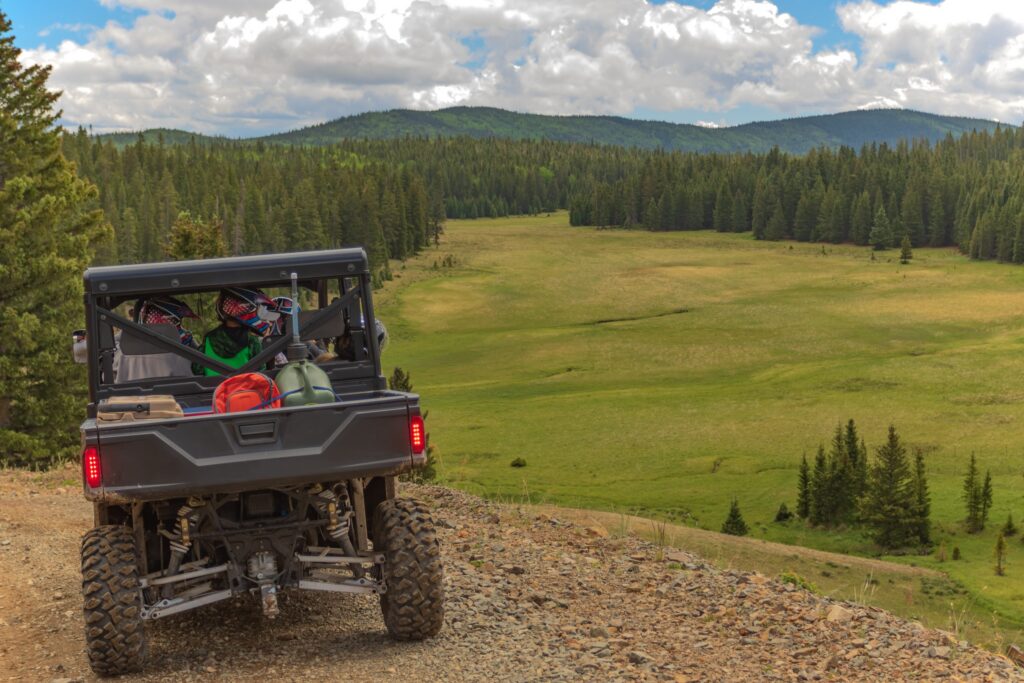
Both machines are safe when they’re matched to the right rider and used responsibly. That said, there are real differences in the ATV vs UTV safety picture worth knowing before you commit.
UTVs come with built-in structural safety advantages: roll cages, three-point seatbelts, and doors on many models. Those features matter in the event of a tip or rollover, which is why side-by-sides are generally considered the more approachable option for beginners and the better fit when kids are part of the equation.
ATVs require active input from the rider. Steering, balance, and body positioning all play a role in keeping the machine stable, especially on slopes and uneven terrain. That’s not a knock against the ATV in the side-by-side vs ATV safety comparison. Riders who take the time to learn their machine and respect the terrain ride ATVs safely every day. The ATV Safety Institute offers training courses that are well worth the time for anyone new to the machine.
Practical safety notes that apply to both sides of the UTV vs ATV comparison:
Recovery is another area where the ATV vs UTV difference shows up in a practical way. UTVs are heavier, which means getting one unstuck usually requires a winch or another vehicle. ATVs are lighter and can sometimes be moved manually in a pinch. That said, a quality winch is worth adding to either machine if you’re riding in remote areas.

Most buyers lock in on the sticker price first. That’s just one piece of the real cost picture in the UTV vs ATV decision.
Purchase price. New ATVs typically run between $5,000 and $12,000, depending on brand, engine size, and how it’s equipped. New UTVs start around $10,000 for basic utility models and climb well past $30,000 for performance or fully-loaded configurations. The ATV vs UTV price gap can get quite large, and so is the capability gap on the upper end. Used machines in both categories are widely available and can represent solid value.
Insurance. UTVs generally cost more to insure than ATVs. The gap is driven largely by higher replacement value and passenger liability. Rates vary significantly based on state, intended use, and whether the machine stays on private land or rides public trails. Get actual quotes before you lock in a budget.
Tires and maintenance. UTVs are heavier and tend to burn through tires faster under hard use. Routine maintenance is generally comparable across both sides of the ATV vs UTV equation, though UTVs with more complex drivetrain setups can carry higher service costs over time.
Resale value. Brand matters here, but condition, maintenance history, and mileage are the main drivers regardless of which side of the UTV vs ATV fence you land on.
A note on buying used UTVs. A used side-by-side that’s been rolled or involved in a hard impact can have a compromised cage, and that damage isn’t always visible from the outside. If you’re shopping used, inspect the roll cage closely for bends, welds, and any sign of structural repair. When in doubt, have a mechanic look it over before you hand over a check.
Total cost of ownership. Add up purchase price, insurance, fuel, tires, storage, and maintenance over several years, and the gap between owning an ATV vs a UTV is real. For buyers working within a tighter budget, an ATV delivers strong capability at a meaningfully lower overall cost. For buyers who genuinely need what a UTV offers, the investment tends to pay off through utility and versatility over time.

Before you pull the trigger on either machine, run through these questions. The answers tend to cut through the noise quickly when deciding between a UTV vs an ATV:

The right machine opens up more of the land you love. At Hayden Outdoors, we understand what it means to put equipment to real use, because that’s how our team operates every day.
Browse our current ATV and UTV listings and find the vehicle that fits your land, your life, and your next adventure.
 Back to Blog