
×

Sign in
Sign in to save favorite properties and equipment, save your search parameters and more
Don’t have an account yet? Sign Up Now
Sign up
Already have an account? Login Now


 866-741-8323
Sign in
Sign in to save favorite properties and equipment, save your search parameters and more
Don’t have an account yet? Sign Up Now
Sign up
Already have an account? Login Now
866-741-8323
Login
Sign in
Sign in to save favorite properties and equipment, save your search parameters and more
Don’t have an account yet? Sign Up Now
Sign up
Already have an account? Login Now
Sign in
Sign in to save favorite properties and equipment, save your search parameters and more
Don’t have an account yet? Sign Up Now
Sign up
Already have an account? Login Now
It’s still dark when you back the trailer down the ramp. The dog is trembling with excitement in the bow, decoys are stacked three crates deep, and somewhere out in the fog, there are birds. That feeling is exactly what duck hunting from a boat is about. Access. Freedom. Water that most hunters will never set foot on.
But a lot of hunters show up to that moment underprepared. Wrong boat. Wrong setup. No real understanding of the regulations, the water, or what’s actually going to separate a good duck hunting season from a forgettable one. The gear is the easy part. What comes before the gear is what this guide covers.
At Hayden Outdoors, we’re not writing this from a desk. Our land specialists spend their days out on the water, running boats before sunup, calling mallards on reservoirs, and staking out in river bottoms when the cottonwoods are bare. Whether you’re new to duck hunting in a boat or just looking to tighten up what you already know, this is the waterfowl sportsman’s guide to doing it right.
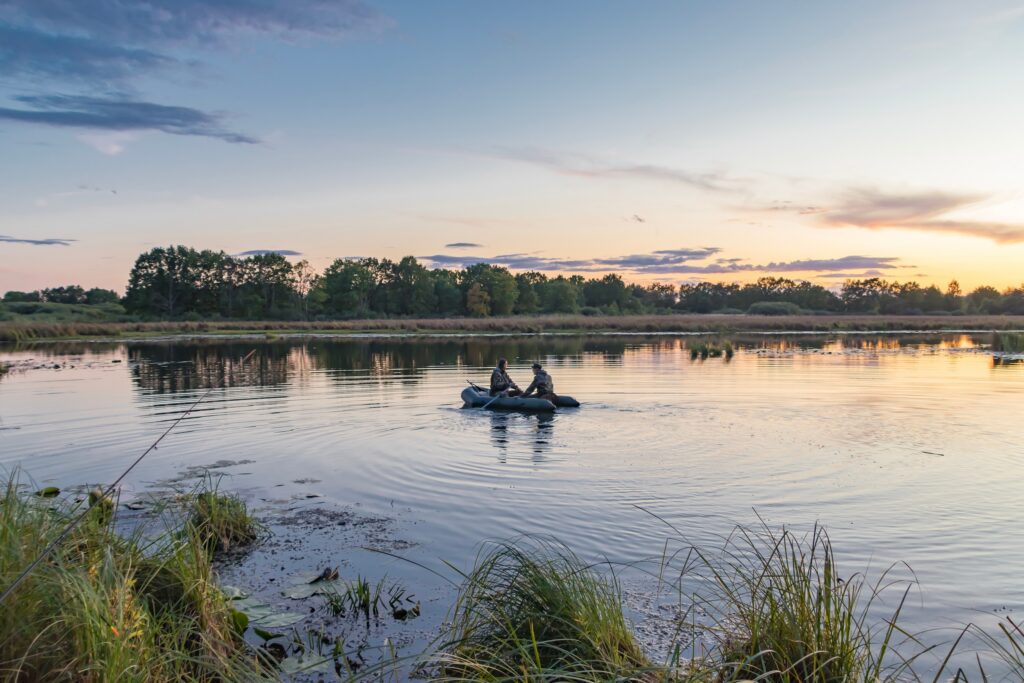
The biggest thing a boat does for a duck hunter is open doors. Land hunters are stuck with whatever they can legally reach on foot. Boat hunters aren’t. A well-rigged jon boat or duck skiff reaches flooded timber, remote marsh, river bends, and open reservoir water that the walk-in crowd never touches. In waterfowl hunting, low-pressure water isn’t just nice to have. It’s the whole game.
Beyond access, duck hunting in a boat gives you the ability to move. When birds aren’t working a hole, you pull the stake and go find them. You’re not married to a fixed blind that may or may not be in the right spot on any given morning. That flexibility is the difference between grinding a cold spot and hunting where ducks actually want to be.
Decoy spreads work better off a boat, too. Open water lets you configure angles and landing zones that a field setup can’t replicate. And a low-profile boat tucked into cattails with a proper camo job is tougher to pick off than most permanent blinds on pressured public land.
Then there’s float hunting, which is its own thing entirely. Quietly drifting a river or pushing through flooded timber, jump-shooting birds that haven’t seen a spread all season. That’s as good as it gets.
Consistently good duck hunting from a boat starts before you leave the ramp. The hunters filling limits aren’t necessarily the best callers or shooters. They’re the ones who did their homework.
Get on your water before the season opens. Look for a working sign: disturbed bottom, scattered feathers, droppings, or vegetation that’s been chewed up by feeding birds. Those spots don’t show up on a map. You find them by running the water and paying attention.
Use onX Hunt and Google Earth to work the water from above. Topo data shows shallow benches, submerged points, and creek mouths that hold birds year after year. Cross-reference that with what you see on the water, and you’ll start building a picture most duck hunters never have.
Pay attention to how conditions change as the season moves. Early teal season looks nothing like late November. A cold front that drops the temperature 20 degrees overnight will move birds off areas they’ve been using all week. River water level affects where ducks feed and where they loaf.
Tidal hunters have to think in tide cycles. The water is always doing something. The duck hunters who adjust to it, rather than expecting birds to be where they were last time, are the ones who stay consistent.
When it comes to duck hunting from a boat, there are two strategies. A lot of hunters default to one without thinking much about the other.
Plenty of hunters take both of these approaches to duck hunting on a boat within the same day. Run early while birds are moving, glass the water from the boat, then lock in on a hole that’s producing and hunt it hard the last hour before the birds go quiet.
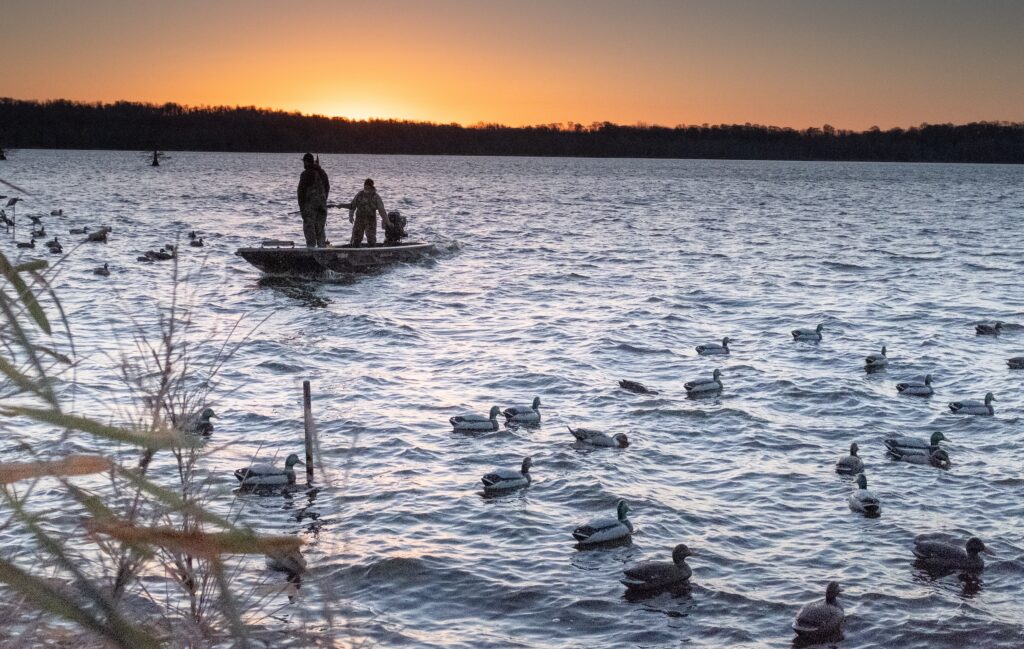
Regulations catch more duck hunters off guard in boat based waterfowl hunting than almost anywhere else. The consequences (fines, license suspension, loss of hunting privileges) are real. Know what you’re walking into before you launch.
Can you duck hunt from a boat? Yes, with a firm federal requirement attached: the boat must be completely stopped and the motor off before you shoot. Under 50 CFR § 20.21, you cannot shoot from a vessel that is moving under power or being actively propelled toward birds. The motor must be off, and the law also prohibits herding or driving birds with a vessel. When it comes to duck hunting, a freely drifting boat is treated differently, but the moment you’re using a motor, paddle, or oar to close the distance on birds, you’re in violation.
Federal Duck Stamp: Per the U.S. Fish & Wildlife Service, every waterfowl hunter 16 and older must carry a valid Federal Duck Stamp. As of the 2024-25 season, thanks to the Duck Stamp Modernization Act of 2023, an electronic E-Stamp is valid all season long and can be carried on your phone or as a printed copy.
State license and waterfowl stamp: On top of the federal stamp, every state requires its own hunting license and waterfowl stamp. Requirements vary. Verify before the duck hunting season opens, not the morning of.
Non-toxic shot: Steel shot is the standard. Bismuth and tungsten alloys are also approved. Federal regulations prohibit possessing lead shot on your person or in your boat while hunting waterfowl, not just in your shells.
Shooting hours: When it comes to duck hunting on a boat, legal shooting time for waterfowl typically runs from 30 minutes before sunrise to sunset; a standard that has held across nearly every season for over a century. Most duck hunters have their boat on the water well before that window opens, which means navigation lights are a legal requirement for pre-sunrise operation. Know your zone’s specific hours and have a reliable way to check sunrise time at your exact location.
Shotgun plug: Shotguns must be plugged to hold no more than three shells total: one in the chamber, two in the magazine.
Boat registration: Current, properly displayed registration is required in virtually every state. This is a must before even considering duck hunting in your boat.
Federal law sets the floor. States routinely go further.
In the core Hayden footprint (Colorado, Nebraska, Kansas, Wyoming, Montana), one of the most common traps for boat hunters is navigable waterway definitions. Whether a particular river bend constitutes public access varies by state. A spot you can legally anchor your boat and go duck hunting in Nebraska may be private bottom one state over. This isn’t a technicality. Game wardens know the difference.
WMAs and national wildlife refuges add another layer. Motorized vessels are prohibited on certain units. Some have vessel length or motor restrictions.
The statewide regs don’t always cover unit-specific rules, so pull the specific regulations for the water you’re hunting – not just the state overview.
When you’re in gray territory, call your local game warden before the hunt. That conversation is a lot easier to have beforehand.
The legal checklist for vessel equipment and the practical checklist for coming home safe are basically the same list. Work through both before the duck hunting season kicks off, not when you’re on your boat at 5 a.m.
Per U.S. Coast Guard regulations, every vessel requires properly fitted PFDs (personal flotation devices) for each person aboard, a throwable flotation device, a fire extinguisher on motorized vessels, and a whistle or horn. Navigation lights are legally required if you’re running before official sunrise, which, again, nearly every duck hunting boat setup does.
Loaded firearm transport laws vary by state. Some prohibit transporting loaded firearms in a vessel regardless of hunting status. Know your state’s specific rules before you run spots with rounds in the gun.
Leave a float plan with someone who will actually act on it. The launch location for your boat, the water you’re duck hunting, and your expected return time. Simple. Non-negotiable in remote marsh and river country.
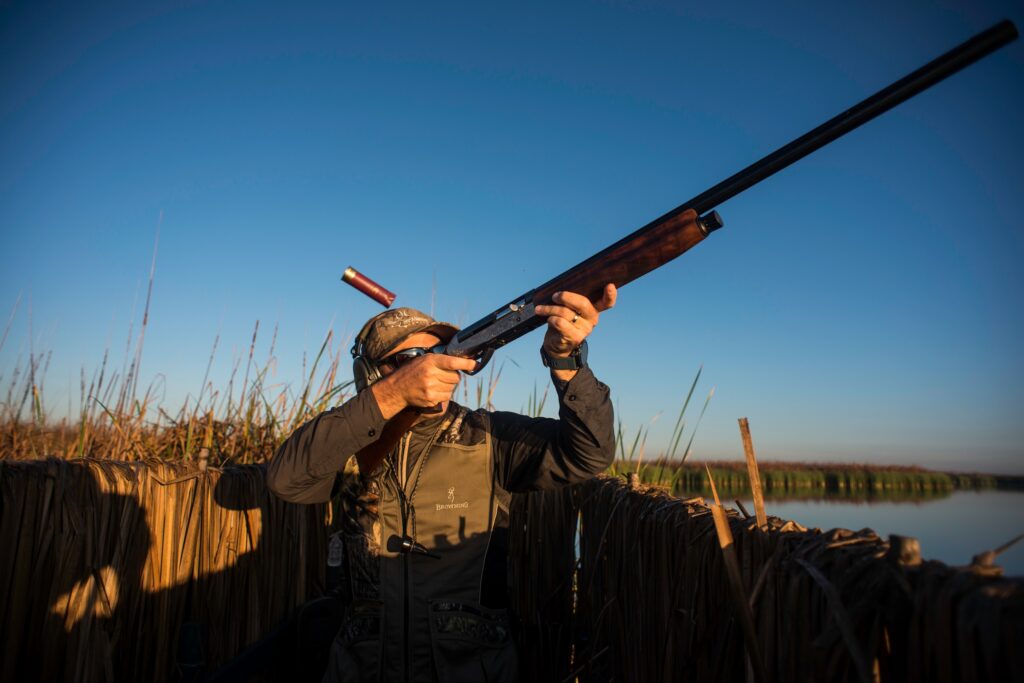
The wrong boat doesn’t just make duck hunting on the water harder. It makes it unsafe, and it costs you birds before you ever throw a decoy. Here’s what matters.
Hull draft is the starting point. If your boat can’t reach the water you’re duck hunting on, nothing else on this list matters. A deep-V hull drawing 18 inches has no business in a foot of marsh water.
Beam width and stability determine whether the boat is actually something you can go duck hunting with. A retriever launching off the side, a hunter standing to shoot, another person leaning over the gunwale to grab decoys; all of that happens when you’re duck hunting on the water. An unstable hull turns that into a problem fast.
Motor compatibility shapes where your duck hunting boat can go and how quietly you can get there. Surface-drive mud motors handle vegetation and skinny water that would wreck a prop. A bow-mounted electric trolling motor lets you make the final approach silently after killing the main motor. Both matter for different reasons.
Noise profile gets overlooked until it kills a hunt. Hull slap on chop, metal decoy clips rattling against aluminum, a motor that sounds like a lawn mower at 200 yards. All of it matters. Foam padding and rubber mounts cost almost nothing and solve most of it.
Weight capacity is almost always underestimated. Two hunters in waders, a 70-pound dog, three dozen decoys, blind material, shells, safety gear, and a cooler full of water add up to a surprising number. Know the rated capacity of your duck hunting boat and build your load around it.
What is the best boat for duck hunting? For most duck hunters starting out, a well-rigged aluminum jon boat is the answer. Versatile, shallow-drafting, and reasonably priced. Mud boats are the call for serious marsh hunting. Layout boats are a specialist tool for open-water diver hunting. Match the boat to the water you actually hunt, not the water you imagine hunting.
When it comes to duck hunting from a boat, it’s worth separating legal restrictions from tactical ones. Both categories cost hunters.
Legal restrictions: Motorized vessels are prohibited in certain WMAs and national wildlife refuges. Some units have vessel length or motor size restrictions. Never assume a water body open to duck hunting is open to your specific boat. Verify unit-specific regulations.
Deep-V bass boats: The high freeboard ruins concealment, and the hull is unstable when you’re constantly leaning over the side. Both problems are serious in a duck hunting boat context.
Pontoon boats: You cannot effectively conceal a pontoon. They’re loud. They’re hard to maneuver in tight channels. Birds will have them patterned before you ever get a chance to call.
Center consoles and open-bow fishing boats: Built for visibility, not concealment, and typically running a motor setup wrong for shallow water. Workable in a limited open-water diver hunting scenario, but wrong for most boat duck hunting situations.
Canoes and kayaks for serious setups: Getting a safe, stable shooting position with a dog, a loaded shotgun, and a full decoy spread in a canoe is genuinely difficult. They have their uses for scouting and light early-season work, but these types of boats are not a real platform for serious duck hunting.
The multi-purpose trap: Boats marketed as hunting and fishing combo rigs are built not to fail at either thing, as opposed to excelling at one. If waterfowl hunting from a boat is your primary use, buy a boat that’s built for it.
Jon boats run the majority of serious duck hunting operations in the country. Flat bottom, shallow draft, versatile. A 16 to 18-foot aluminum jon handles flooded timber, river systems, and marsh edges better than anything else at the price point.
Mud boats and surface-drive rigs are purpose-built for dense marsh, vegetation-choked flats, and water too shallow for a prop. The motor rides on top of the vegetation rather than through it. If thick cattail marsh or coastal grass flats are your primary ground for duck hunting, this is the boat.
Layout boats sit extremely low in the water and are purpose-built to be invisible to birds on approach. They require a tender boat and aren’t a beginner’s setup. For open-water diver hunting, nothing does what a layout boat does.
Purpose-built duck skiffs have become more popular among those serious about duck hunting who want more capability than a basic jon boat without going full specialty rig. Good stability, reasonable draft, designed to carry a blind.
Airboats access marsh that nothing else can reach, but they’re loud. In hunting situations where noise matters (which is most of them), the commotion of an airboat approach can push birds before shooting hours. Situational at best.
Getting the right boat for your duck hunting mission is half the job. But your setup is the other half of the equation.
Boat blind system: A PVC frame stuffed with local vegetation (e.g., cattails, marsh grass, whatever grows where you hunt) is the most natural-looking option. Commercial blind kits are faster and sturdier. Most serious hunters run a commercial backing frame and pack it with local material. Natural always blends better.
Camo treatment: Flat spray paint in tan, olive, and brown does the job and costs almost nothing. Camo wraps for your boat are more durable for a full duck hunting season of hard use. Whatever you use, eliminate anything that catches light.
Stake-out poles: Silent anchoring in soft-bottom shallow water. Driving a pole rather than dropping an anchor means no splash, no chain noise. In calm conditions, that difference is the difference.
Dog platform and ramp: If you’re running a retriever, this isn’t optional. A stable, anti-slip platform at water level lets your dog work without destabilizing the boat during a duck hunting mission. A wet Lab scrambling over a gunwale on a dark morning is both dangerous and disruptive.
Trolling motor mount: Kill the main motor at a distance, trim down, and move in on electric. The birds that would flush at 200 yards from a running outboard will hold for a trolling motor approach. This modification pays for itself the first morning you use it.
Drainage and organization: Decoys and dogs move water into the hull constantly. A bilge pump, non-slip mat, and a thought-through organization system (dedicated decoy crate positions, waterproof boxes, shell caddies) keeps a chaotic duck hunting boat under control.
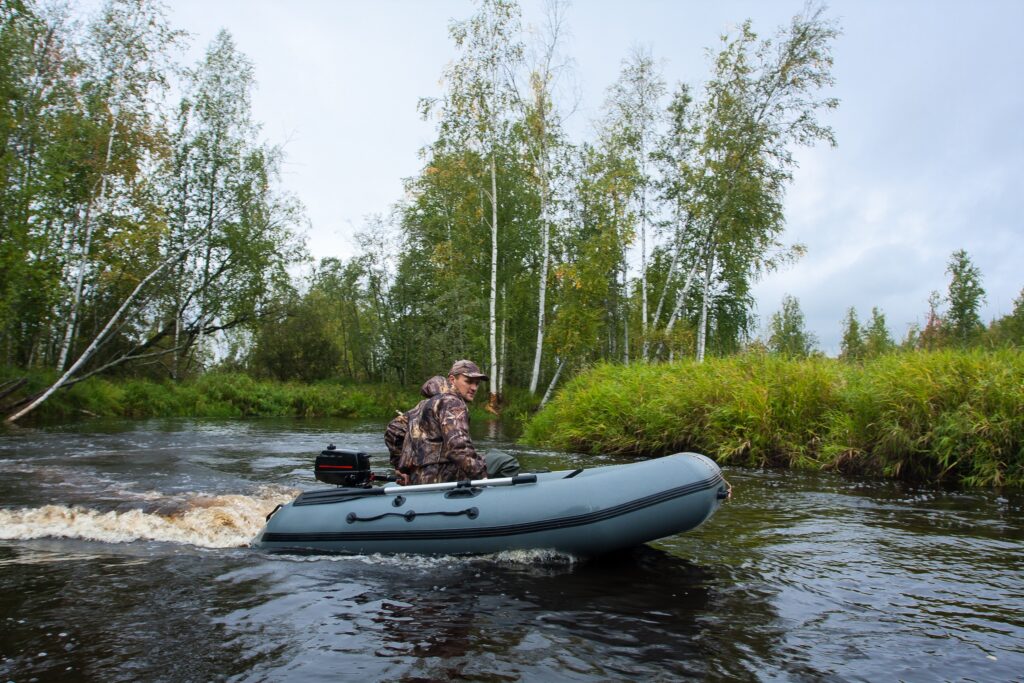
The right boat is only half of the duck hunting equation. There are a few gear elements that can have a substantial impact on your success rates.
A decoy spread is a system, not a shopping cart. How you rig and configure matters as much as how many ducks are in the water.
In still water, weighted-keel decoys are fast to deploy and hold their position. In current (rivers, tidal flats, anywhere the water moves), a Texas rig with a heavy anchor keeps your spread from bunching into an unnatural pile downwind. Match your rig to your water.
Dabblers work best in tighter spreads near cover with a clear landing hole positioned upwind of the blind. Divers want open-water rafts that read as a big flock already committed to a spot. When duck hunting from a boat on open reservoir water, bigger is generally better for a diver spread.
Motion matters. A spinning-wing decoy on a calm day with light pressure is a bird magnet. On heavily worked public water, birds pattern spinning wings fast – know when to take it down. Jerk rigs and water-agitators produce natural ripple movement that reads well in any conditions.
Organize decoys for dark deployment. Mesh bags drain well but tangle. Stackable plastic crates keep things sorted by species and string length. Whatever you run, practice it before opening morning.
Almost nobody talks about how duck hunting from a boat changes calling, due to sound carrying differently over open water. On a flat, calm reservoir, a mallard call is louder to incoming birds than the same call blown with the same air in a flooded cornfield. Hunters who don’t account for that come in too hot. Volume that reads as confidence in a field reads as panic on open water. Start lighter.
When birds are circling and showing interest, the instinct to keep calling is usually the wrong move. Birds working an open-water setup have been looking at your spread from a long way out. They’ve already made a decision. Calling frantically when they’re close doesn’t help it.
Know your duck species. Mallards want hen calls and feeding chuckles. Teal are fast and respond to a whistle. Pintail and wigeon have their own sounds. Divers (bluebills, canvasbacks) want soft grunting purrs, not the loud quacks that work on dabblers. Carry the duck calls that match the water you’re hunting.
Caller positioning matters inside the blind. In an open-water duck hunting in a boat setup, birds can pick up hand and face movement from farther out than most hunters expect. Call from a position where you’re not silhouetted against the sky, and keep the movement tight.
Open water at 7 a.m. in November is not the same as a flooded field at 7 a.m. in November. There’s no windbreak. Every knot of wind comes straight across the water and hits you full. Duck hunters who dress for field hunting and find themselves on a boat in a big reservoir in a north wind find out the hard way.
Moisture-wicking base layer first. Wet underlayers from sweat or spray accelerate heat loss faster than cold air alone. An insulating mid-layer (e.g., fleece or synthetic down) holds warmth even when the outer layer gets wet. A waterproof, windproof shell is not optional when duck hunting from a boat in serious conditions.
On the chest waders vs. bibs question: if you’re wading regularly to set decoys or make retrieves, waders make sense. If you’re primarily in the boat when duck hunting, waterproof bibs are less restrictive and keep you plenty dry.
Cover your hands and face. Both are heat loss points, and both give you away to incoming birds. Neoprene gloves with trigger access and a good face mask earn their place in a serious boat hunting setup.
A retriever is half the hunt on open water. Without one, cripples in the current disappear. With a bad one (or a good one that hasn’t been prepared for boat work), you’ve got a different kind of duck hunting problem.
Not every retriever translates to boat hunting. Labs and Chesapeakes are the standard for cold-water boat work. The coat, the drive, the temperament; they’re built for it. A dog that holds beautifully in a field blind but won’t settle in a rocking, confined boat with decoys splashing and birds working overhead is a liability when duck hunting, not an asset.
Getting a dog right for boat hunting takes time. Work them in the boat in the off-season. Get them steady on the rock and noise before there are real birds involved. A dog that breaks early without stable footing in a loaded duck hunting boat is dangerous to everyone on board.
A dog platform at water level with an anti-slip surface is non-negotiable. Without one, a big dog trying to re-board over the gunwale can flip a jon boat or land on another hunter.
Is it safe for dogs to duck hunt in a boat? Yes, with preparation. A neoprene vest adds buoyancy and insulation for cold-water work. In river current, know where the downstream eddies are, keep retrieve distances manageable, and always track where the dog is relative to the boat. A dog overboard in fast water before sunrise is an emergency. Plan for it before it happens.
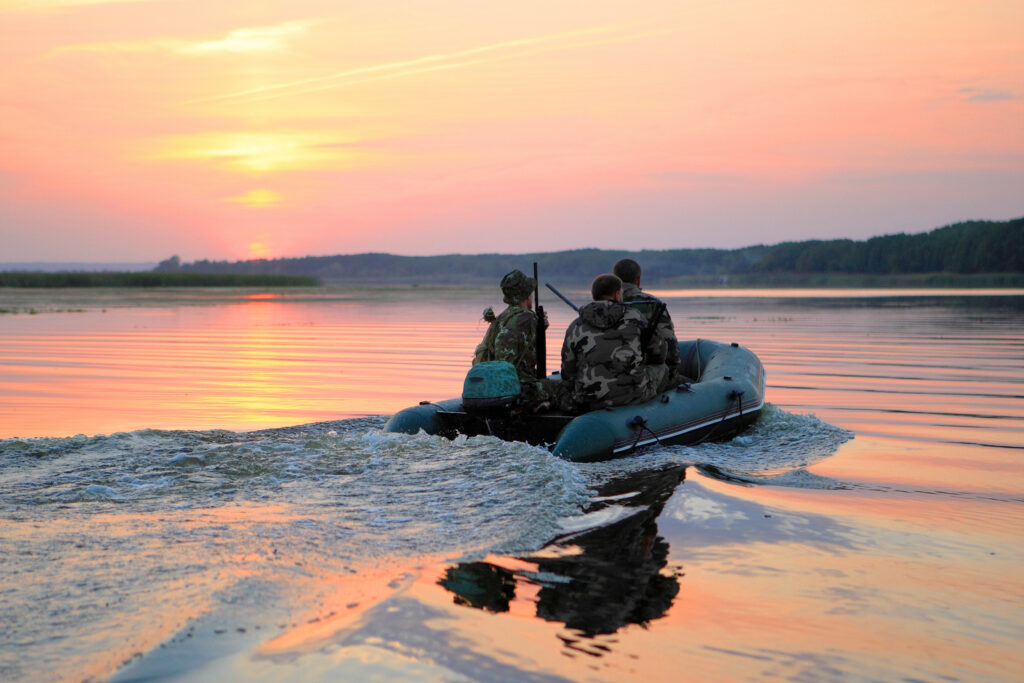
Duck hunting from a boat stacks risk factors that don’t usually show up together: loaded firearms, unstable footing, pre-dawn darkness, and cold water. Any one of them is manageable. All four together, without preparation, is a different situation.
Assign shooting zones before the hunt starts. Every hunter in the boat gets a lane. Crossing shots are agreed on before birds are working, not in the moment. Muzzle awareness in a confined boat demands more attention than it does in an open field. There’s less room, and things happen faster.
Wear your PFD when duck hunting from a boat. The difference between traditional foam and an auto-inflating model comes down to whether you’ll actually keep it on. Inflatables are comfortable enough that hunters wear them consistently. They do require regular inspection; the CO2 cartridge needs to be functional. A PFD in the hull does nothing. Auto-inflating chest packs have become the standard among those serious about duck hunting from a boat for exactly this reason.
Cold water is more dangerous than most hunters give it credit for. Air temperature and water temperature aren’t apples to apples. At the water temperatures common during duck season (40 to 55 degrees Fahrenheit), cold shock starts within one to three minutes of immersion. That means involuntary gasping, rapid breathing, and spiking blood pressure before you’ve had time to process what happened. Most cold water deaths occur before hypothermia fully sets in. A PFD and a float plan aren’t overly cautious. They’re what keep a bad situation from becoming a fatal one.
Unload every firearm every time the motor runs. Before you pull the stake. Before you trim up the trolling motor.
What should a sportsman consider when hunting from a boat? Shooting lanes, PFD use, cold water risk, legal hours, boat setup and concealment, decoy strategy, species ID, and the specific regulations for the water being hunted. Every hazard that exists in field hunting exists when duck hunting in a boat, and most of them are amplified.
Solo duck hunting from a boat is common, but it demands a higher standard than a two-person hunt, because the margin for error is smaller.
Leave a detailed float plan with someone who will act on it. Specific launch ramp, specific water, expected return time, and a clear instruction for when to call search and rescue. In remote marsh and river country, that plan is your backup system.
Cell service fails in a lot of the best duck hunting spots. A handheld VHF marine radio and a satellite communicator (Garmin inReach and SPOT are the most common among serious hunters) fill that gap. They’re a minor expense relative to what a search and rescue operation costs.
Solo hunters need to apply a harder cutoff on marginal conditions. High wind on open water, strong river current, ice, and low visibility fog are conditions a two-person boat can navigate more safely than a solo rig. The birds will be there tomorrow. Go tomorrow.
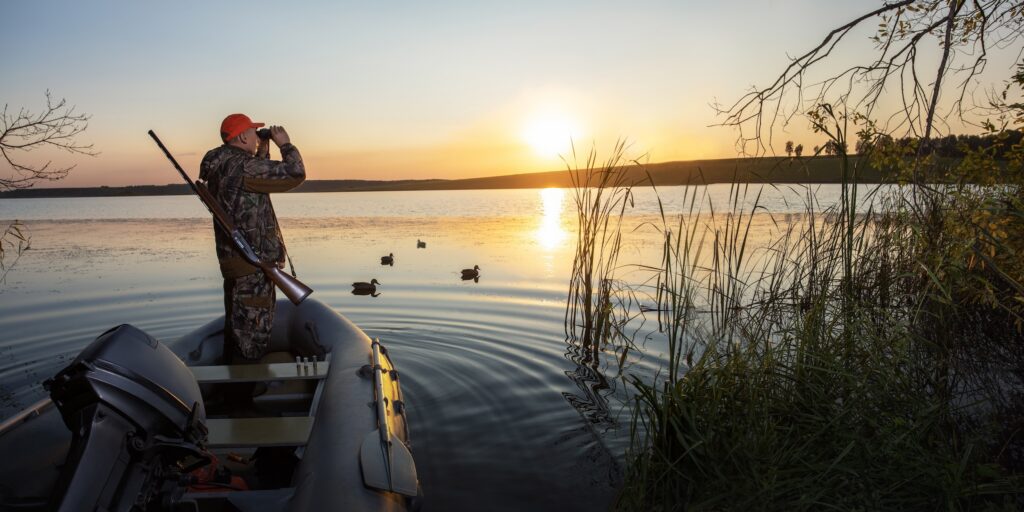
Everything else in this duck hunting guide (the right boat, the right setup, the regulations knowledge) is preparation for one thing: being in the right place when birds want to be there. It’s the last variable, and the one most hunters underinvest in.
Public water gets worked over. By the third week of the season, ducks on heavily pressured public marshes and reservoirs have seen every spread on that water and been shot at from every angle. They pattern hunter behavior faster than hunters pattern birds. Early-season public water can be productive. As the season moves, the advantage consistently shifts to unhunted ground.
Build your location strategy around pre-season scouting. Run your water before opener. Mark where birds are using. Identify feeding flats, travel corridors, and loafing areas. Pull eBird migration data for your specific flyway to understand timing and staging patterns. Then hunt what you’ve found rather than where you went last year.
Wind and weather make location decisions every morning. A duck hunting setup that was perfect on a calm day with an east wind is wrong when a north front comes through and rocks the boat. Birds approach into the wind. Your blind needs to deliver them with the sun at their backs and the decoys in front of your gun. Adjust your anchor daily when you have to.
Is float hunting legal? Yes, in most states. The federal restriction is that you cannot shoot from a vessel moving under power or being actively propelled toward birds.Check state-specific rules and any WMA restrictions before the trip, since some managed units add their own vessel use limitations.
Private water is a different world. Hunters who’ve hunted both don’t need it explained. For hunters who haven’t made that comparison yet, here’s the short version.
Birds on private water haven’t been educated. Decoys work. Calls get responses. The fundamentals of duck hunting from a boat, the things you practiced and prepared for, actually perform as intended, rather than getting countered by ducks that have seen every play in the book.
Exclusive access to private marsh, flooded agricultural fields, river bottoms, or private reservoir water means you learn the water over years, not just mornings. By the fifth season you’re hunting a private piece, you know things about it that no public land hunter could. That knowledge compounds.
Private ag land next to water is some of the most productive duck hunting ground available. Flooded fields and grain stubble adjacent to marsh or river is the combination waterfowl want most: food and safety, close together. That’s what drives the most consistent duck hunting from a boat in the central flyway.
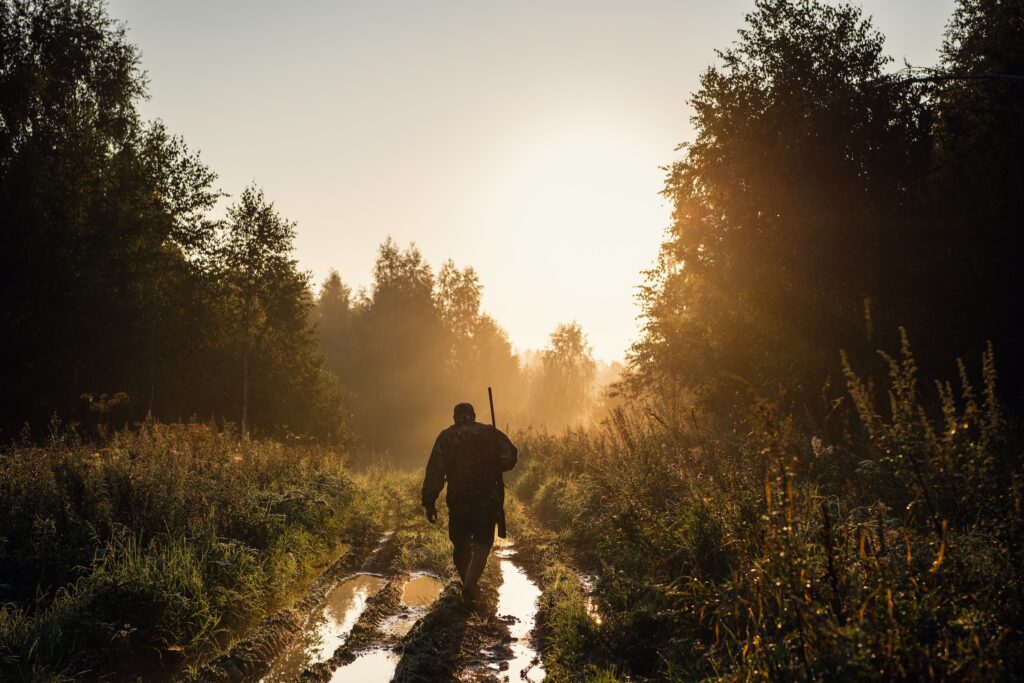
Private waterfowl ground doesn’t stay on the market long. Properties with real duck hunting value, like private marsh, river bottoms, flooded ag ground, and reservoir access, are genuinely rare. The people who own them hold on.
Our agents at Hayden Outdoors understand waterfowl properties because they hunt them. They know the difference between land that looks good on a map and land that actually produces birds when conditions are right. That perspective matters when you’re looking at a property you want to hunt for the next twenty years, not just the next season.
If you’re looking to buy private duck hunting ground, or just want to talk through what makes a waterfowl property worth owning, our team is the right call.
 Back to Blog